.png)
.png)

Why Won't My Car Start? 12 Common Causes and What to Do Next
- avancezassistltd
- Jun 13
- 5 min read
Few things are more frustrating than getting into your car, turning the key or pressing the start button, and finding that nothing happens. Whether you're heading to work, collecting the children, or setting off on a long journey, a vehicle that won't start can quickly disrupt your day.
While a flat battery is the most common cause, it's far from the only reason a vehicle may fail to start. Problems with the starter motor, alternator, fuel system, ignition or even the vehicle's security system can all prevent your engine from running.
The good news is that many issues have obvious warning signs, and there are several safe checks you can carry out before calling for assistance.
In this guide, we'll explain the 12 most common reasons why a car won't start, what you can safely check yourself, and when it's time to contact Avancez Assist Ltd for professional roadside assistance and vehicle recovery.

1. Flat Battery
The most common reason a vehicle won't start is a discharged battery.
Typical signs
Slow engine cranking
Clicking sound when turning the key
Dim dashboard lights
Weak headlights
No electrical power
Flat batteries are especially common during cold weather or if the vehicle hasn't been driven for several days.
2. Faulty Starter Motor
If the dashboard lights come on normally but the engine doesn't turn over, the starter motor may have failed.
Signs include
Single click when starting
No engine movement
Battery appears healthy
Intermittent starting problems
Starter motors often wear gradually before failing completely.
3. Alternator Failure
The alternator charges your battery while the engine is running.
If it fails, the battery will eventually discharge completely.
Warning signs
Battery warning light
Flickering headlights
Electrical faults
Vehicle stalls while driving
Battery repeatedly goes flat
4. Empty Fuel Tank
It sounds obvious, but it's surprisingly common.
Faulty fuel gauges or assuming there's enough fuel left can leave drivers stranded.
Always check the fuel level first.
5. Faulty Key or Immobiliser
Modern vehicles rely on electronic security systems.
If the immobiliser doesn't recognise the key, the engine may refuse to start.
Common symptoms include:
Immobiliser warning light
Engine cranks but won't fire
Dashboard displays key error
6. Dead Key Fob Battery
Push-button start vehicles depend on the key fob battery.
A flat key battery may prevent the vehicle recognising the key.
Many vehicles allow emergency starting by holding the key against the start button.
Check your owner's manual for the correct procedure.
7. Loose or Corroded Battery Terminals
A good battery is useless if power can't reach the vehicle.
Corrosion around the terminals can interrupt the electrical connection.
Signs include:
Intermittent starting
Flickering dashboard lights
Clicking noises
8. Fuel Pump Problems
If fuel isn't reaching the engine, it cannot start.
Possible signs include:
Engine cranks normally
No attempt to fire
Whining noise from fuel tank
Loss of power before breakdown
9. Blown Fuse or Electrical Fault
A blown fuse can disable essential systems.
Modern vehicles contain dozens of electronic control units, meaning even a small electrical fault can prevent starting.
10. Ignition System Failure
Petrol vehicles rely on spark plugs and ignition coils.
Common symptoms include:
Engine turns but won't fire
Misfiring before failure
Rough running
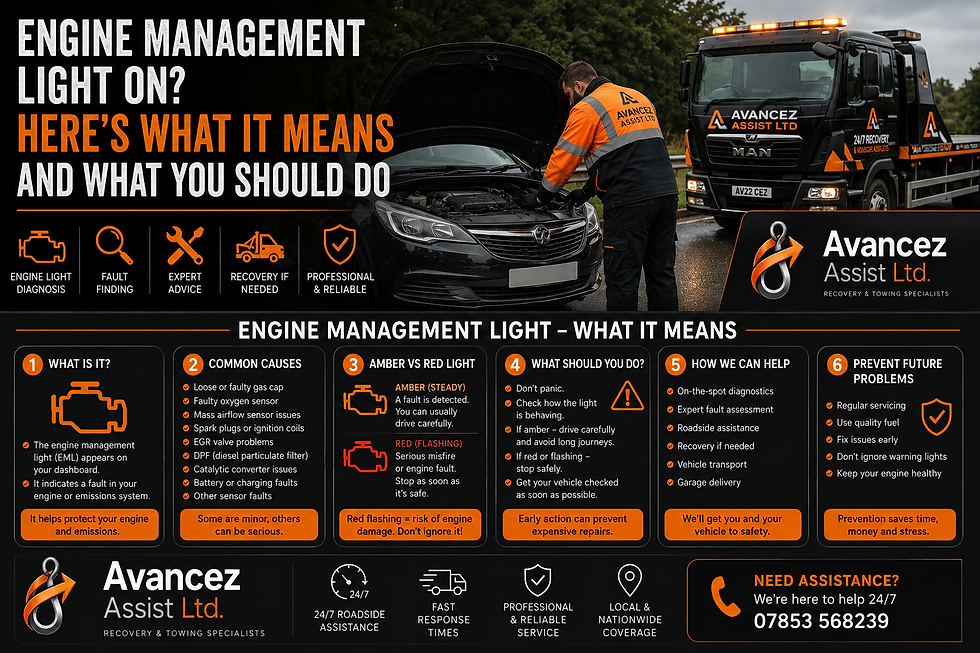
11. Engine Management Fault
Modern vehicles monitor hundreds of sensors.
If a critical sensor fails, the engine control unit (ECU) may prevent the engine from starting to protect it from damage.
If the engine management light has been illuminated for some time before the breakdown, diagnostic testing may be required.
12. Mechanical Engine Failure
Although less common, internal engine problems such as timing belt failure or severe mechanical damage can prevent a vehicle from starting.
Signs include:
Unusual metallic noises
Engine spins unusually quickly
Sudden loss of power before stopping
Oil pressure warning light
These issues require professional diagnosis and recovery.
What Can You Safely Check Yourself?
Before calling for assistance, there are several simple checks you can carry out safely.
✔ Is the vehicle in Park or Neutral?
✔ Is there enough fuel?
✔ Are the battery terminals secure?
✔ Do the dashboard lights illuminate?
✔ Are the headlights bright?
✔ Have you tried the spare key?
✔ Are there any warning lights?
✔ Can you hear the fuel pump priming?
Never attempt roadside repairs if you're in an unsafe location or on a motorway.
When Should You Call Professional Recovery?
It's time to contact a recovery company if:
The vehicle won't crank.
A jump start doesn't work.
Warning lights remain illuminated.
The vehicle repeatedly goes flat.
You're stranded in an unsafe location.
You suspect a mechanical or electrical fault.
You're unsure of the cause.
Attempting repeated starts can sometimes make the problem worse.
How Avancez Assist Ltd Can Help
At Avancez Assist Ltd, we provide fast, reliable roadside assistance and vehicle recovery 24 hours a day.
Our services include:
Vehicle recovery
Roadside assistance
Battery jump starts
Vehicle transport
Nationwide vehicle collection and delivery
Accident recovery
Non-running vehicle transport
Where it's safe to do so, we'll always try to get you moving again. If the problem can't be resolved at the roadside, we'll recover your vehicle safely to your chosen destination.
Frequently Asked Questions
Why won't my car start even though the lights come on?
This may indicate a faulty starter motor, poor battery connection or another electrical fault rather than a completely flat battery.
Can cold weather stop my car starting?
Yes. Low temperatures reduce battery performance and can make starting more difficult, particularly if the battery is ageing.
Can I jump start every vehicle?
No. Some hybrid and electric vehicles require specialist procedures. Always follow the manufacturer's guidance.
How long should a car battery last?
Most batteries last between three and five years, depending on driving habits and maintenance.
Why does my battery keep going flat?
Repeated battery failures may indicate an alternator fault, an electrical drain or a battery that has reached the end of its service life.
Should I keep trying to start the engine?
Repeated attempts can flatten the battery further and may worsen certain mechanical faults.
Is it safe to wait inside my vehicle?
If you're in a safe location, yes. If you're on a motorway or smart motorway, follow National Highways guidance and move to a place of safety if possible.
Final Thoughts
A vehicle that won't start can be caused by anything from a simple flat battery to a more complex mechanical or electrical fault. Understanding the most common causes can help you identify the problem more quickly and decide whether it's something you can safely check yourself or whether professional assistance is needed.
If you're ever unsure, don't take unnecessary risks. Avancez Assist Ltd provides dependable 24/7 roadside assistance, vehicle recovery and nationwide vehicle transport, helping drivers get back on the road safely and efficiently. Whether it's a flat battery, starter motor issue or something more serious, our experienced team is ready to help whenever you need us.

Comments