.png)
.png)

What Is the Engine Management Light? What Causes It to Come On?
- avancezassistltd
- Jun 16
- 5 min read
Has your engine management light suddenly appeared on your dashboard? Don't panic—but don't ignore it either.
The engine management light (also known as the check engine light or MIL – Malfunction Indicator Lamp) is one of the most common warning lights drivers encounter. While it doesn't always mean there's a serious fault, it is your vehicle's way of telling you that something isn't working as it should.
In this guide, we'll explain what the engine management light means, why it comes on, what you should do next, and when it's safe to keep driving.
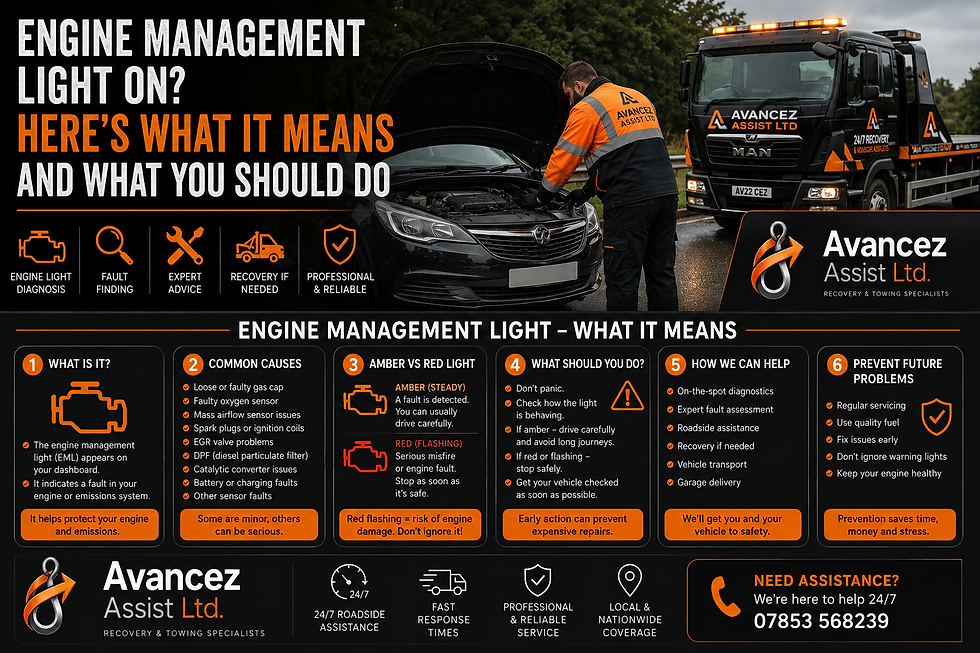
What Is the Engine Management Light?
The engine management light is part of your vehicle's On-Board Diagnostics (OBD) system. Modern vehicles constantly monitor hundreds of sensors that measure how your engine, emissions and fuel systems are performing.
If the system detects a fault that could affect:
Engine performance
Fuel economy
Exhaust emissions
Ignition
Fuel delivery
Turbocharger operation
Emission control systems
it stores a fault code and illuminates the engine management light on your dashboard.
The warning light itself usually appears as a small engine-shaped icon and is often amber or yellow.
What Does the Engine Management Light Mean?
The meaning depends on how the light behaves.
Steady Amber Light
A steady engine management light usually indicates a fault that requires attention soon but may not be an immediate emergency.
Your vehicle may still drive normally, although you might notice:
Reduced fuel economy
Slight loss of power
Rough idle
Increased emissions
Difficult starting
In many cases, you can continue driving carefully to a garage for diagnostics.
Flashing Engine Management Light
A flashing engine management light is much more serious.
It usually means the engine is misfiring badly enough to potentially damage the catalytic converter.
If the light is flashing:
Reduce your speed immediately.
Avoid heavy acceleration.
Pull over somewhere safe if the vehicle is running poorly.
Arrange recovery if necessary.
Ignoring a flashing engine warning light can lead to expensive repairs.
Common Causes of an Engine Management Light
1. Faulty Oxygen (Lambda) Sensor
One of the most common causes.
The oxygen sensor measures the amount of oxygen in the exhaust gases so the engine can adjust the fuel mixture correctly.
Symptoms include:
Increased fuel consumption
Rough running
Failed MOT emissions test
2. Loose or Damaged Fuel Cap
Believe it or not, something as simple as a loose fuel cap can trigger the engine management light.
A poor seal allows fuel vapours to escape, causing the emissions system to detect a leak.
Always check the fuel cap is tightened properly after refuelling.
3. Faulty Mass Air Flow (MAF) Sensor
The MAF sensor measures how much air enters the engine.
If it fails, the engine may:
Hesitate
Stall
Lose power
Use more fuel
4. Ignition Coil or Spark Plug Problems
On petrol vehicles, worn spark plugs or faulty ignition coils often cause:
Engine misfires
Rough idle
Poor acceleration
Flashing engine warning light
5. Diesel Glow Plug Faults
On diesel vehicles, glow plugs help with cold starts.
Faulty glow plugs can trigger warning lights and cause:
Hard starting
Excessive white smoke
Poor cold running
6. EGR Valve Problems
The Exhaust Gas Recirculation (EGR) valve helps reduce emissions.
Over time it can become clogged with carbon deposits.
Symptoms include:
Loss of power
Poor acceleration
Black smoke
Increased fuel consumption
7. Diesel Particulate Filter (DPF) Issues
If the DPF becomes blocked, it can trigger the engine management light.
Common signs include:
Reduced power
Increased fuel consumption
DPF warning light
Limp mode
Regular motorway journeys help the DPF regenerate.
8. Turbocharger Problems
Modern turbocharged engines rely on sensors to monitor boost pressure.
Faults with:
Turbo actuators
Boost hoses
Pressure sensors
Wastegate systems
can all illuminate the warning light.
9. Fuel Injector Problems
Blocked or faulty injectors can cause:
Misfires
White smoke
Poor performance
Difficult starting
Increased fuel consumption
Diesel injector faults are particularly common on higher-mileage vehicles.
10. Catalytic Converter Problems
A damaged catalytic converter can trigger the engine warning light and reduce engine performance.
Common causes include:
Previous engine misfires
Oil contamination
Overheating
Internal damage
Replacement catalytic converters can be expensive, so early diagnosis is important.
Can I Still Drive With the Engine Management Light On?
It depends on how the vehicle is behaving.
Generally Safe to Drive (Carefully)
You may be able to continue driving if:
The light is steady.
The engine feels normal.
No unusual noises are present.
There is no excessive smoke.
No warning messages indicate overheating or low oil pressure.
Arrange for a diagnostic check as soon as possible.
Stop Driving Immediately If:
The light is flashing.
The engine is shaking violently.
There is significant loss of power.
The vehicle enters limp mode.
You notice excessive smoke.
You smell burning.
The engine temperature rises.
Continuing to drive could cause severe engine damage.
What Is Limp Mode?
Many modern vehicles protect themselves by entering limp mode when a serious fault is detected.
In limp mode, the vehicle may:
Limit engine power.
Restrict acceleration.
Prevent high engine speeds.
Reduce turbo boost.
Limit vehicle speed.
Although you may still be able to drive a short distance, the vehicle should be inspected promptly.
How Is the Fault Diagnosed?
The first step is to connect an OBD-II diagnostic scanner to the vehicle.
This allows a technician to read the stored fault codes and identify which system has detected a problem.
It's important to remember that a fault code identifies the affected system—not always the exact failed component. Further testing may be needed before replacing parts.
Can the Engine Management Light Turn Itself Off?
Yes.
If the issue was temporary—for example, a loose fuel cap—the light may go out after several successful driving cycles once the problem has been corrected.
However, if the underlying fault remains, the light will usually return.
Simply clearing the fault code without repairing the cause is not recommended, as the warning light is likely to reappear.
How Can You Prevent the Engine Management Light From Coming On?
Regular maintenance greatly reduces the risk of engine warning lights.
Good practices include:
Servicing your vehicle on schedule.
Replacing air and fuel filters as recommended.
Using quality fuel.
Checking fluid levels regularly.
Addressing unusual noises or warning signs promptly.
Taking diesel vehicles on longer journeys to allow DPF regeneration.
Preventative maintenance is almost always cheaper than major repairs.
Need Roadside Assistance?
If your engine management light has appeared and your vehicle has lost power, entered limp mode, or is no longer safe to drive, Avancez Assist is here to help.
Our experienced recovery operators provide 24/7 roadside assistance, breakdown recovery, and vehicle transport. Whether you need help at the roadside or safe transport to a trusted garage, we'll get you and your vehicle where you need to be—quickly, safely, and professionally.
Why Choose Avancez Assist?
✓ 24/7 Breakdown Recovery
✓ Fast Response Times
✓ Professional Vehicle Transport
✓ Modern Recovery Equipment
✓ Fully Insured Service
✓ Friendly, Experienced Operators
✓ Support for Cars, Vans, Hybrids & EVs
Professional Recovery. Rapid Response. Nationwide Reliability.
Frequently Asked Questions
Is it illegal to drive with the engine management light on?
Not necessarily. A steady light doesn't automatically make your vehicle illegal to drive, but if the fault affects emissions or safety, it could result in an MOT failure or further damage if ignored.
Will an engine management light cause an MOT failure?
A malfunction indicator lamp (MIL) that remains illuminated for an engine or emissions-related fault is generally an MOT failure on vehicles where it is required to operate correctly.
Can low battery voltage trigger the engine management light?
Yes. A weak battery or charging system fault can sometimes cause electronic control modules to log fault codes and illuminate the engine management light.
How much does it cost to diagnose an engine management light?
Many garages charge a diagnostic fee, which can vary depending on the vehicle and the level of investigation required. Some include the scan free of charge if you proceed with the repair.


Comments